Can I check my health from my phone for my work plan without leaving my house?
How a group insurance health scan from phone removes friction from benefits enrollment, lifts participation, and reaches distributed workers without a clinic visit.
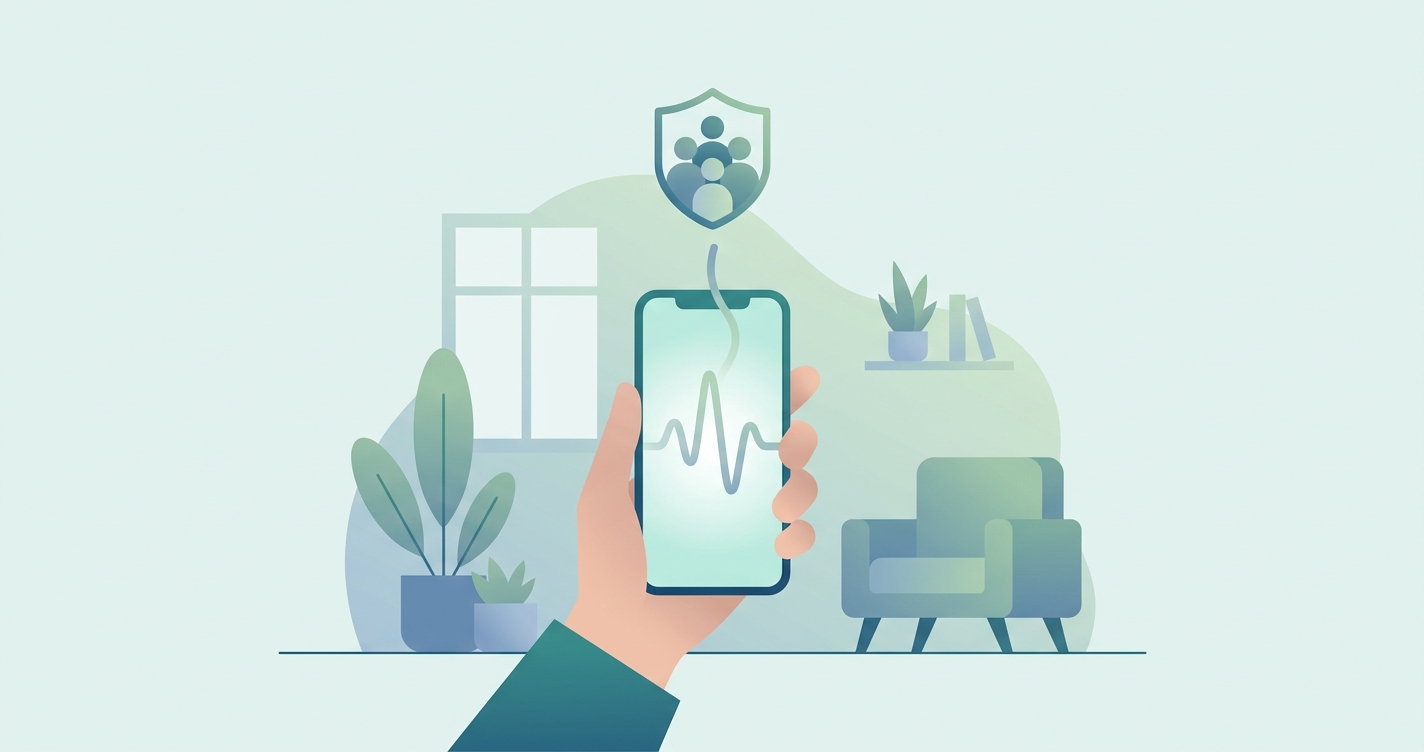
The short answer for an employee asking whether they can check their health from a phone for a work plan is yes, and the longer answer is reshaping how carriers and benefits teams think about enrollment. A group insurance health scan from phone uses the camera and sensors already in a worker's pocket to capture biometric signals at home, on their own schedule, with no clinic appointment, no lab kit in the mail, and no half-day off work. For the benefits consultants, TPA administrators, and carriers who design these programs, the question is no longer whether the technology works. It is whether the convenience translates into the participation rates that make a screening program actuarially useful.
Most preventive benefits go unused. Industry reporting in 2025 found that the majority of employees never complete the preventive screenings their plans already pay for, and at-home options exist specifically to close that gap. Source: Employee Benefit News, 2025.
That participation gap is the entire business case. A screening program that 30 percent of a group completes produces a thin, biased data set. The same program at 70 percent completion becomes a usable underwriting and population-health input. Removing the trip to a clinic is one of the most direct levers on that number.
Why a group insurance health scan from phone changes the participation math
Traditional biometric screening forces a logistical choice on every employee: book a clinic visit, attend an on-site event on a fixed day, or complete a mailed lab kit with a fasting blood draw. Each step sheds participants. Remote workers, multi-site staff, shift workers, and caregivers are the ones most likely to drop off, and they are also the populations carriers most want to measure.
A phone-based scan compresses that funnel. The worker opens a link, follows a guided capture using the front-facing camera, and the system estimates vitals from the video signal. The underlying method is remote photoplethysmography (rPPG), which reads tiny color changes in the skin caused by blood flow. A 2025 review of smartphone PPG vital-sign measurement and Google Research's passive heart-rate work both document the maturation of this approach, with camera-based heart-rate estimation reaching mean percentage error under 10 percent against ECG in the Google study.
The convenience story matters to three buyers at once:
- Carriers gain a larger, less self-selected data set for group life and supplemental underwriting.
- TPAs and benefits consultants gain a differentiated enrollment experience that lifts completion without on-site logistics.
- Employees gain a private, fast assessment they can finish at their kitchen table.
Comparing how employees can complete a work-plan health check
The table below frames the three dominant models a benefits team can offer, from the employee's point of view and the administrator's.
| Screening method | Employee effort | Typical completion friction | Reaches remote/multi-site staff | Administrative overhead |
|---|---|---|---|---|
| On-site clinic event | Attend on a fixed date at a set location | High: scheduling, travel, time off | Poor for distributed teams | High: vendor staffing, space, scheduling |
| Mailed lab kit | Self-collect sample, fast, mail back | Moderate to high: fasting, shipping, delay | Good in theory, low return rates | Moderate: kit logistics, lab turnaround |
| Phone-based health scan | Open link, guided camera capture at home | Low: minutes, no travel, no fasting | Strong: anyone with a smartphone | Low: digital distribution and dashboards |
The pattern is consistent. The closer a program gets to the device an employee already owns, the lower the friction and the wider the reach. That does not make phone scanning a clinical replacement for every measurement, but for the screening-tier signals that group programs rely on, it removes the steps where participants disappear.
Industry applications
Benefits enrollment and open enrollment windows
Open enrollment is the largest annual data-collection opportunity in employer-sponsored coverage, and it is also the most time-compressed. A phone scan fits inside the existing digital enrollment flow. An employee selecting a voluntary benefit or a higher group life tier can complete a scan in the same session, on the same device, rather than being routed to a separate clinic appointment that many will never book.
Distributed and multi-site workforces
The remote-work shift made on-site events structurally inadequate. Gallup's 2025 analysis notes fully remote workers report higher work engagement (31 percent) than hybrid or on-site peers, yet they sit outside the reach of a clinic set up in a corporate lobby. A from-phone scan is the only model that treats a warehouse worker in one state and a remote analyst in another as equally reachable.
Voluntary and supplemental benefits
Voluntary products live or die on participation and clean risk signals. When the health check is frictionless, more employees opt in, and the carrier prices against a broader pool rather than a self-selected slice of the most or least health-conscious.
Current research and evidence
The evidence base for camera-based vitals has moved quickly. A 2025 review of PPG-based vital-sign measurement using smartphone cameras catalogs the methods and their accuracy ranges, with heart rate the most robust signal and blood pressure still the most variable. A separately reported 2025 non-contact PPG mobile study cited heart-rate accuracy around 99 percent and oxygen-saturation accuracy in the low-to-mid 90s, with weaker blood-pressure performance. Google Research's passive heart-rate monitoring work, published through Nature, reported mean percentage error under 10 percent versus ECG using a front-facing camera.
Two caveats belong in any benefits design conversation. First, accuracy depends on conditions the program cannot fully control: lighting, motion, camera quality, and skin tone all affect rPPG signal quality, as the 2025 reviews note. Second, screening-tier estimates are not diagnostic measurements, and program materials should frame them as wellness and risk-stratification inputs rather than clinical results.
On the demand side, the 2025 Wellable wellness trends report and contemporaneous benefits reporting both point to employers shifting toward flexible, remote-friendly screening to lift engagement, while the contactless health monitor market is projected to grow from roughly 5.5 billion dollars in 2025 toward 15 billion by 2035 at a 10.6 percent compound annual rate. The direction of travel is clear even where individual accuracy figures remain method-dependent.
The Future of from-phone group health screening
The next phase is less about whether a phone can read a vital and more about how that signal plugs into existing benefits infrastructure. Expect three developments to define the category.
- Integration depth: scans embedded directly inside ben-admin and enrollment platforms, so the health check is a step in the flow rather than a separate destination.
- Risk-tiering rather than pass/fail: carriers using scan signals to route employees into guaranteed-issue, simplified-issue, or fuller-underwriting paths, instead of a single binary decision.
- Longitudinal capture: because the barrier to a repeat scan is so low, programs can move from an annual snapshot toward periodic check-ins that feed population-health and stop-loss models with trend data.
The constraint will not be the camera. It will be governance: consent, data minimization, clear separation between what an employer sees and what a carrier uses, and honest communication that screening estimates are not diagnoses. Programs that handle those well will convert convenience into trust, and trust into the participation rates that make the data worth collecting.
Frequently asked questions
Can an employee really complete a work-plan health check from home using only a phone? Yes. A group insurance health scan from phone uses the device's camera to estimate biometric signals through remote photoplethysmography, so a worker can complete a guided capture at home in minutes without a clinic visit, lab kit, or fasting.
How accurate is a phone-based health scan compared with a clinic measurement? Accuracy varies by signal. 2025 research and Google Research's work show heart rate is the most reliable, often within about 10 percent of ECG, while blood pressure remains more variable. These are screening and wellness estimates, not diagnostic clinical measurements, and conditions like lighting and motion affect quality.
Why do carriers and benefits consultants prefer phone-based screening? It lifts participation. Because most employees skip preventive benefits and on-site events miss remote and multi-site staff, a from-phone option reaches more of the group, producing a larger and less self-selected data set for underwriting and population-health programs.
Does the employer see the individual results? Well-designed programs separate identifiable health data from the employer and route it to the carrier or administrator under appropriate consent and privacy controls. Clear data governance is central to participation, and employees should review how each program handles their results.
Circadify is building scalable, from-phone biometric screening for exactly this problem: turning low-friction participation into usable group enrollment and wellness data. Benefits consultants and carriers evaluating the model can explore an enterprise pilot program to test participation and data quality against their own population.