
Health Screening for Association and Affinity Group Insurance
An analysis of health screening for association and affinity group insurance, including enrollment design, data governance, and group pricing implications.
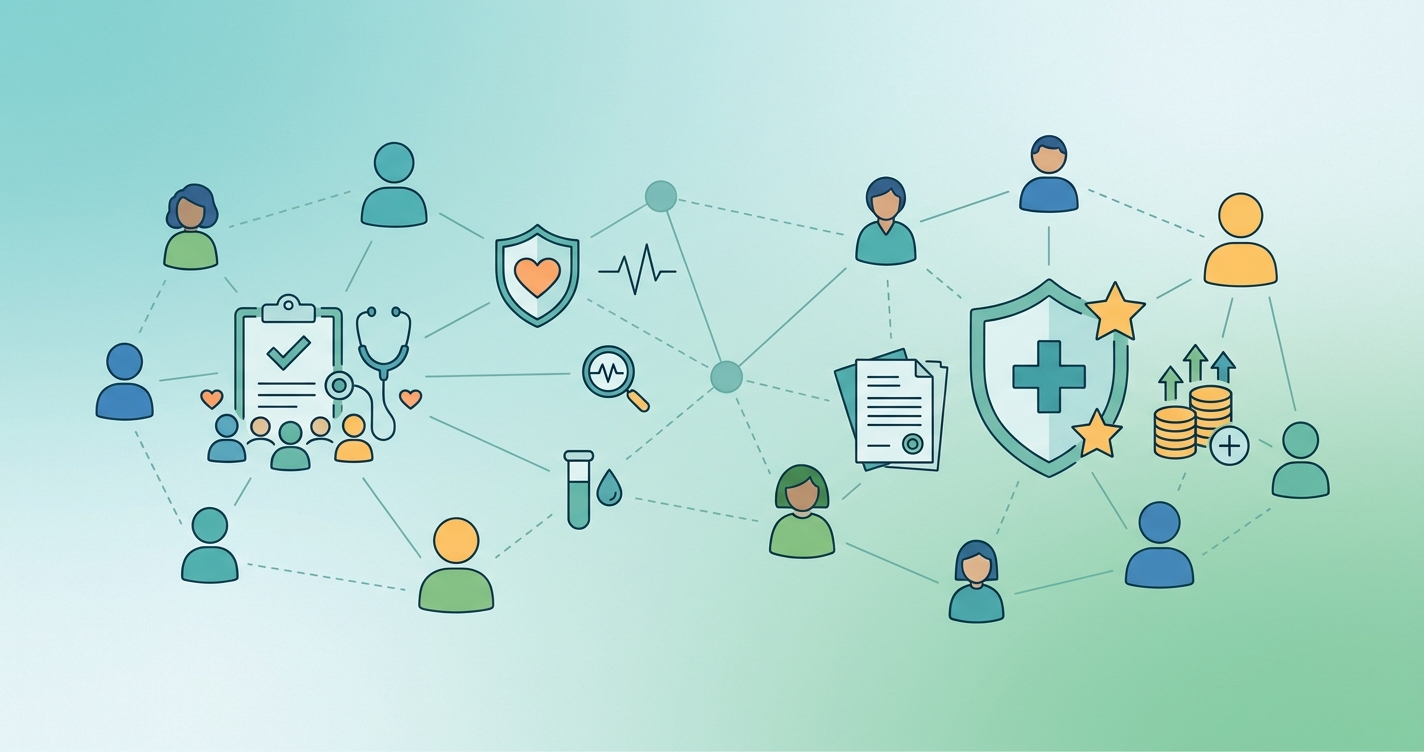
Association and affinity group insurance has always depended on one basic promise: a shared membership base should make coverage easier to distribute and easier to price. What has changed is the amount of health information available at enrollment. Health screening for association and affinity group insurance is becoming relevant because carriers, administrators, and benefits consultants are trying to make group decisions with fewer onsite events, more digital enrollment, and tighter rules around what member organizations can actually do with health data.
The 2025 KFF Employer Health Benefits Survey found that 43% of larger firms offer biometric screening opportunities, a sign that screening is moving closer to the mainstream in employer-sponsored coverage even though enrollment and underwriting workflows still lag behind.
Why health screening matters in association and affinity group insurance
Association and affinity groups are not typical single-employer plans. They often bring together professional associations, franchise networks, trade groups, alumni communities, or other member organizations whose members share an identity but not always the same worksite, payroll system, or risk profile. That creates distribution advantages, but it also creates data gaps.
A carrier may know a member belongs to a chamber, trade association, or professional society. That does not mean the carrier has a current picture of the member's health status, participation likelihood, or risk mix across the enrolled block. In older group models, that gap was handled with blunt tools: age bands, broad class rating, paper forms, and occasional onsite screening events. In a digital market, those tools look slow.
The policy pressure is also real. In April 2024, the U.S. Department of Labor rescinded the 2018 Association Health Plan rule and returned to a narrower reading of what counts as a bona fide employer association under ERISA. Lisa M. Gomez, Assistant Secretary for Employee Benefits Security, said the move was meant to align association coverage with the "best reading of the statutory requirements governing group health plans." For carriers and administrators, that means association programs need cleaner operating models, clearer governance, and stronger member-level evidence.
What screening can and cannot do for affinity programs
Health screening does not solve the legal structure of an association plan. It does not create commonality of interest, and it does not remove ACA or privacy obligations. What it can do is improve how the program operates once the coverage model is valid.
In practice, screening helps with four problems:
- Identifying likely participation patterns before a launch or renewal
- Distinguishing broad population segments instead of pricing every member as if the risk mix were identical
- Reducing the logistical cost of serving geographically scattered members
- Giving benefits administrators a more current health snapshot than stale questionnaires provide
That matters because affinity groups are usually dispersed. A national trade association or franchised business network cannot rely on one annual screening fair in a hotel ballroom. The economics break quickly.
| Program Question | Traditional affinity-group workflow | Screening-enabled workflow |
|---|---|---|
| How is member risk estimated? | Census files, age, geography, self-report | Census plus current screening indicators and engagement data |
| How is screening delivered? | Onsite events or paper follow-up | Remote digital workflow during enrollment or campaign windows |
| Which groups benefit most? | Centrally located associations | Distributed, multi-state, and hard-to-reach memberships |
| What drives pricing confidence? | Historical claims and broad assumptions | Historical claims plus fresher population-level signals |
| What slows rollout? | Scheduling, staffing, low attendance | Data permissions, workflow design, member communication |
| Main governance concern | Incomplete evidence | Consent, retention, and approved use of data |
Why association programs are different from large-employer wellness programs
It is tempting to treat this as a copy-and-paste version of employer wellness. That usually misses the point. RAND's workplace wellness study found that fewer than half of employees in surveyed firms underwent clinical screening or completed a health risk assessment. Even in employer settings with payroll access, internal communications teams, and established benefit channels, participation is hard.
Association and affinity programs face a harder version of the same problem. The sponsoring organization may have a trusted brand, but it often has less day-to-day control over members than an employer has over employees. That makes convenience decisive. Screening has to fit naturally into digital enrollment, renewal, or campaign flows. If it feels like an extra errand, completion rates usually fall.
KFF's 2025 survey also shows why the pressure is building. Family premiums reached $26,993, and employers continue looking for ways to improve plan design without simply shifting more cost to members. Association-sponsored programs are under the same economic pressure. They need better ways to understand the enrolled population without rebuilding the program around expensive in-person events.
Current research and evidence on data sharing and trust
The technical question is easy compared with the trust question. C. Grundstrom, Olli Korhonen, K. Väyrynen, and M. Isomursu wrote in a 2020 JMIR Medical Informatics study that insurance customers expect reciprocity when they share health data. In their survey of 5,000 customers from a Finnish insurer, respondents wanted clear value in return, such as personalized digital services or financial compensation, and they worried about profiling, premium increases, or denied claims.
That finding travels well to association and affinity group insurance. Members may be open to screening if the use case is narrow, understandable, and clearly separated from inappropriate data reuse. They are much less comfortable when the request feels vague or one-sided.
A workable operating model usually includes:
- Explicit member consent tied to a stated enrollment or program purpose
- Clear explanation of whether individual data, aggregate data, or both will be used
- Retention limits and deletion rules documented up front
- Separation between program guidance and any decisions that require separate underwriting authority
- A member-facing value exchange, such as faster enrollment, better benefit matching, or lower administrative friction
That is not just a compliance checklist. It is also a participation strategy. When people understand why a screening is happening, they are more likely to complete it.
Industry applications for carriers, TPAs, and benefits consultants
Trade and professional associations
Professional groups often market insurance as a membership benefit, but the member base can span many states and employer sizes. Screening gives carriers a way to understand the population without turning the program into a traveling event operation. For benefits consultants, it also creates a cleaner story around product fit and renewal planning.
Franchise and multi-location member networks
Franchisees and local affiliates may share a brand while operating independently. That makes them structurally similar to many affinity programs: common identity, uneven operational maturity, and distributed geographies. Remote screening workflows help standardize program intake across the network.
Voluntary and supplemental lines
Affinity programs are often strongest in supplemental products because enrollment is lighter and member messaging is easier to target. Health screening can improve how those offers are segmented, especially when the goal is matching members to more relevant product bundles rather than pretending every member should buy the same thing.
The future of health screening for association and affinity group insurance
The next phase will probably look less like medical underwriting and more like program calibration. Screening data will be used first to improve enrollment design, participation targeting, and population-level planning. Over time, some programs may connect screening to more dynamic pricing or product eligibility decisions, but that will only happen where governance is tight and members trust the exchange.
This is also where contactless models become more practical. Association and affinity groups need something lighter than staffed screening events and more current than paper forms. Circadify is building for that gap, bringing contactless health screening into insurance workflows so distributed groups can collect a current health snapshot without scheduling nurses or shipping equipment. More detail is available at circadify.com/industries/payers-insurance.
For buyers, the key question is no longer whether screening belongs in group insurance at all. It is whether the workflow respects the structure of association programs: scattered members, limited administrative bandwidth, and high sensitivity around how health data is used.
Frequently Asked Questions
What is association and affinity group insurance?
It is insurance offered through a member-based organization such as a trade association, professional society, alumni network, or similar group. The group helps aggregate demand, but the legal and regulatory structure still matters.
Why would these programs use health screening?
Mainly to improve enrollment design, participation forecasting, and population-level understanding. In some cases, screening can also support product matching or streamlined evidence gathering.
Is health screening the same thing as underwriting?
Not always. In many association programs, screening is used first for engagement, segmentation, or benefits design rather than individual underwriting. The specific use depends on the product and the approved program structure.
What usually blocks adoption?
Consent design, member trust, unclear legal structure, and poor workflow integration are the most common obstacles. The technical part is often easier than the governance part.
If you are comparing approaches, Biometric Screening in Group Insurance: What Data Actually Helps? and TPA Guide to Digital Health Screening in Group Insurance are good next reads. For a broader operations view, see How Launching a Group Health Screening Pilot Program Actually Works.