How Long Does Employer Health Screening Take in 2026?
How long does employer health screening take in 2026? A turnaround analysis of onsite events versus phone-based scans for carriers, TPAs, and consultants.
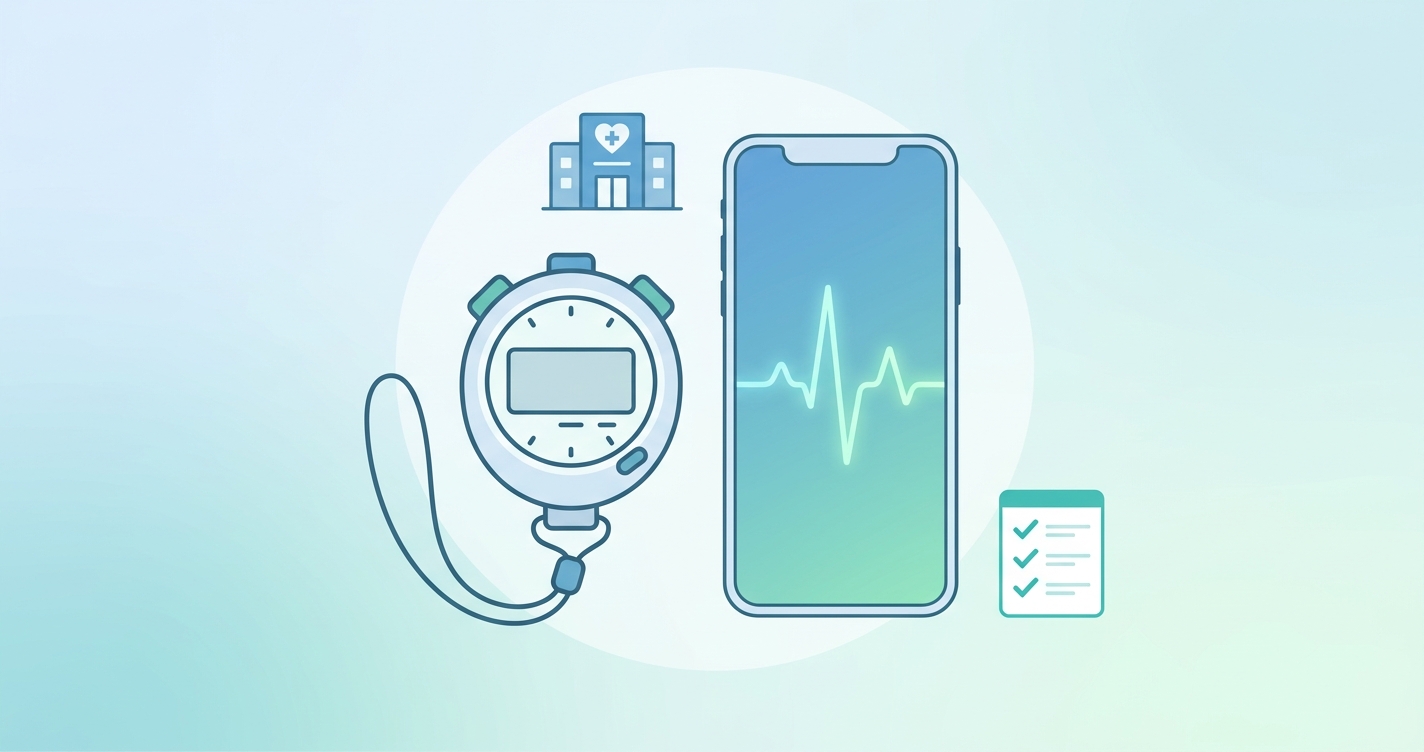
The question of how long does employer health screening take has quietly become a procurement-grade variable rather than a logistics footnote. For group insurance carriers, TPA administrators, and benefits consultants, the gap between a screening that resolves in seconds and one that resolves in weeks now decides participation rates, data completeness, and whether usable population health data lands inside the enrollment window at all. As employer-sponsored programs shift toward phone-based biometric capture, the timeline math is changing fast enough that the old assumptions baked into renewal cycles no longer hold.
In 2024, 44% of large firms and 9% of small firms offered workers the opportunity to complete a biometric screening, and 65% of large firms attached incentives to drive completion, according to the Kaiser Family Foundation Employer Health Benefits Survey. Yet median participation in unincentivized programs sits near 20%, a gap that turnaround time directly influences.
How long does employer health screening take across delivery models
The honest answer is that screening completion time splits into two distinct clocks: the time an individual employee spends being screened, and the time before the carrier or TPA receives usable data. These are often confused in vendor conversations, and the confusion costs administrators weeks of latency they did not budget for.
For a traditional onsite event, the per-employee appointment runs roughly 10 to 15 minutes, based on operational benchmarks from established screening providers such as Quest Diagnostics and Mobile Health. That figure excludes scheduling, travel to the screening room, queueing, and the staffing required to run an event for a distributed workforce. The data clock is separate. Fingerstick results may be available immediately or within 3 to 5 days, venipuncture results typically post online within 1 to 3 days with a mailed report arriving in 10 to 14 days, and offsite lab processing extends to 7 to 14 business days. At-home kits, often pitched as the convenient alternative, can take up to four weeks to return results.
Phone-based biometric screening compresses both clocks at once. The employee interaction can resolve in under a minute, and because the capture is digital, the data is structured and available without a lab handoff. For an administrator trying to close an enrollment window on schedule, the difference between a four-week kit cycle and a same-session digital capture is the difference between actionable data and a stale file.
| Screening method | Per-employee time | Data turnaround | Best fit |
|---|---|---|---|
| Onsite event (fingerstick) | 10-15 min | Immediate to 3-5 days | Concentrated single-site workforces |
| Onsite event (venipuncture) | 10-15 min | 1-3 days online, 10-14 days mailed | Programs needing full lipid panels |
| Offsite lab / clinic voucher | 15-30 min plus travel | 7-14 business days | Dispersed employees near labs |
| At-home test kit | 10-20 min | Up to 4 weeks | Remote workforces, low urgency |
| Phone-based digital scan | Under 1 minute | Same session | Large, distributed, time-boxed enrollment |
The table makes the structural point clear: the methods that minimize per-employee friction are not always the ones that minimize data turnaround, and only phone-based capture collapses both at the same time.
Why screening completion time drives program outcomes
Turnaround is not an isolated metric. It compounds through the rest of the program in ways that benefits consultants increasingly model before recommending a vendor.
- Longer per-employee time depresses participation, especially among shift workers and remote staff who cannot easily attend a scheduled event.
- Slower data turnaround pushes results past the enrollment decision window, reducing how much underwriting and wellness value the data can produce.
- Multi-week timelines force administrators to run reminder campaigns and reschedule no-shows, raising the operational cost per screened life.
- Delayed results weaken the feedback loop, and research from Optum found participants who receive screening results are roughly twice as likely to engage in follow-up wellness coaching.
The participation stakes are concrete. Well-structured incentive programs have pushed participation as high as 99%, while unincentivized programs cluster near a 20% median. Friction and turnaround sit on the causal path between those two numbers. A screening that takes a minute on a device an employee already owns removes most of the practical excuses that drag participation down.
Industry applications of faster screening timelines
Group insurance carriers
For carriers, the screening timeline determines whether biometric data arrives in time to inform rating and renewal. Employer biometric screening technology that delivers same-session results lets carriers build population risk pictures during the enrollment window rather than after it closes. That timing supports more responsive renewal pricing and reduces reliance on stale or self-reported inputs.
TPA Administrators
Third-party administrators absorb the operational weight of slow screening. Every additional week of turnaround multiplies across the book in reminder emails, reschedules, and reconciliation work. Fast health scan enrollment shifts the administrative model from event coordination to digital distribution, which scales far more cleanly across multiple employer clients running concurrent enrollment periods.
Benefits Consultants
Consultants are increasingly asked to defend a recommended screening timeline against the client's enrollment calendar. A vendor that can promise sub-minute capture and same-session data gives the consultant a defensible answer to the executive question of when results will actually be ready. The screening timeline becomes a differentiator in the bid, not an afterthought.
Current research and evidence
The evidence base points in a consistent direction. The 2024 Kaiser Family Foundation Employer Health Benefits Survey documented that biometric screening remains a standard feature among large employers, with 44% offering it and a majority using incentives to lift completion. The persistence of the roughly 20% unincentivized participation median, also reflected in Shortlister's 2024 and 2025 Workplace Wellness Trends reports, shows that access and friction, not employee indifference alone, constrain participation.
On the value side, Optum's analysis of biometric screening impact reported a reduction of about $24.25 per participant per month, or roughly $291 per year, in subsequent medical costs, alongside the finding that screened employees engage in coaching at higher rates. Those returns depend on actually capturing the data and returning results quickly enough to drive behavior. The market context reinforces the trend: multiple 2025 market reports, including from MarketsandMarkets and Verified Market Research, project continued growth in employee biometric screening driven substantially by technology that digitizes consent, capture, and results management.
What the literature does not yet contain is a large, head-to-head peer-reviewed comparison of phone-based optical capture against traditional venipuncture turnaround at enterprise scale. That gap is where the next wave of validation work will concentrate, and benefits buyers should read current vendor turnaround claims with that evidence ceiling in mind.
The future of employer health screening timelines
The direction of travel is toward eliminating the event entirely for the majority of low-complexity screenings. As phone-based capture matures, the expectation among benefits buyers is shifting from "how do we schedule the screening" to "how do we distribute the link." Several developments are likely to define the next few cycles:
- Screening will move from a calendar event to an always-available enrollment step embedded in the benefits platform.
- Same-session results will become the baseline expectation, with multi-week kit cycles treated as a fallback for specific clinical needs.
- Carriers will integrate screening data directly into underwriting workflows, shrinking the gap between capture and pricing decisions.
- Hybrid models will pair instant digital capture for the broad population with targeted lab confirmation for flagged cases, optimizing both speed and clinical depth.
The organizations that win the next round of group business will be the ones that treat screening completion time as a design constraint rather than a vendor disclosure buried on page nine of a proposal.
Frequently asked questions
How long does a phone-based employer health screening take per employee? Phone-based biometric scans can resolve in under a minute, compared with 10 to 15 minutes for a typical onsite appointment, before accounting for scheduling and travel. The larger advantage is that digital capture returns structured data in the same session rather than after a lab cycle.
Why do traditional screening results take so long to arrive? Lab-based methods depend on sample handling and processing. Venipuncture results post online in 1 to 3 days but the mailed report can take 10 to 14 days, offsite lab work runs 7 to 14 business days, and at-home kits can take up to four weeks. Each handoff adds latency the carrier or TPA cannot control.
Does a faster screening timeline actually improve participation? The evidence suggests yes, indirectly. Median participation in unincentivized programs sits near 20%, while well-designed programs reach far higher. Removing the time and scheduling friction of an event addresses one of the main practical barriers to completion.
Can screening data be ready inside the enrollment window? With same-session digital capture, yes. That timing is what lets carriers and consultants use the data for renewal and wellness decisions during enrollment rather than after it closes, which is rarely possible with multi-week lab or kit cycles.
Circadify is building scalable biometric screening designed to close the gap between capture and usable data for group enrollment, with the kind of same-session turnaround that benefits consultants and carriers increasingly require. Teams evaluating how to compress their screening timeline can explore an enterprise pilot program to see how digital capture fits an existing enrollment workflow.