
Year-Round Health Monitoring vs Annual Biometric Events: Compared
A research-based comparison of year-round health monitoring vs annual biometric events for employers, carriers, and benefits teams evaluating screening strategy in 2026.
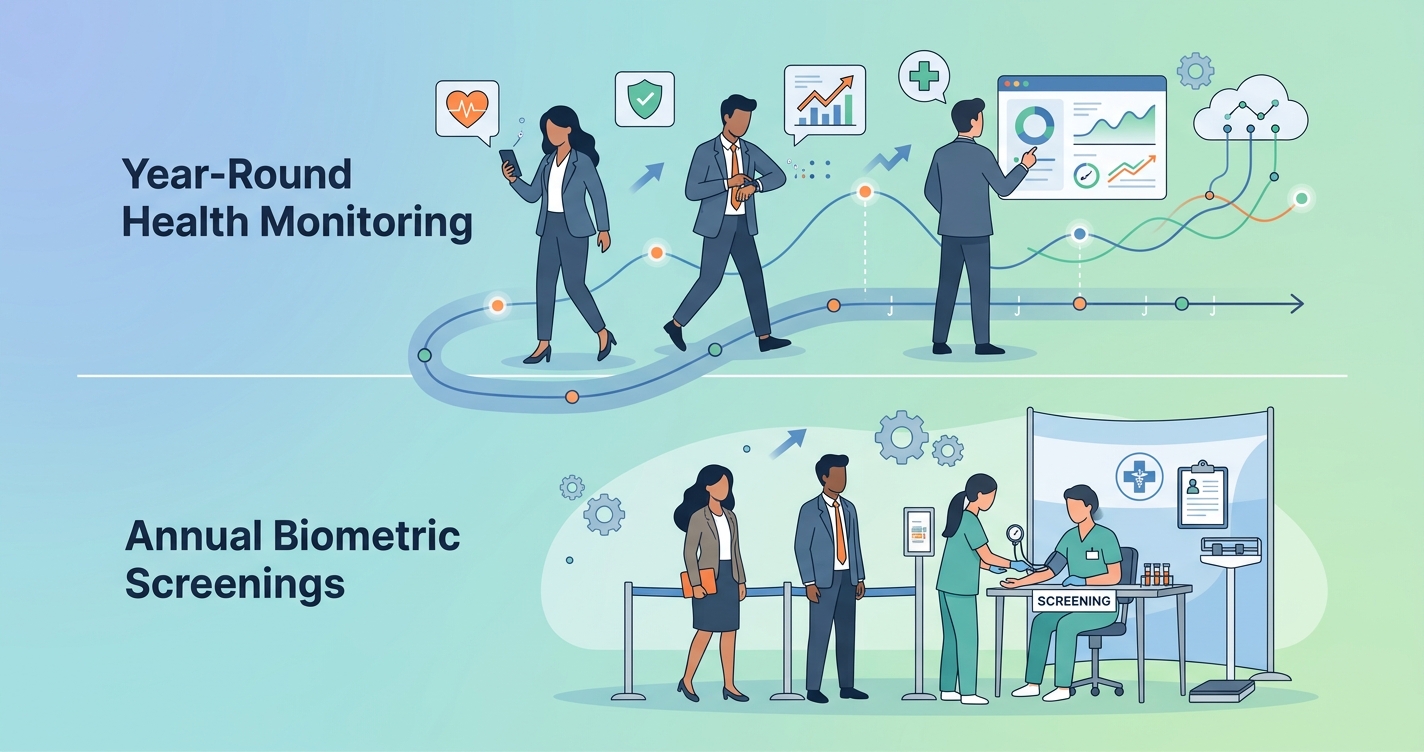
The debate around year round monitoring vs annual biometric events has become more urgent as employers, carriers, and benefits consultants face higher health benefit costs and more pressure to show measurable value from screening programs. Annual events still have a place. They produce a standardized snapshot, they fit renewal calendars, and buyers already understand them. But a once-a-year snapshot can miss the operational reality of workforce health, especially when eligibility, participation, and risk status shift throughout the year.
"After 18 months, participants reported higher rates of regular exercise and active weight management, but there were no significant effects on clinical health measures, health care spending, or employment outcomes." — Zirui Song and Katherine Baicker, JAMA, 2019
Year-round health monitoring vs annual biometric events: what is actually being compared?
At a basic level, the comparison is not just about frequency. It is about what kind of decision a buyer is trying to support.
Annual biometric events are usually built for one of four jobs: open enrollment campaigns, wellness incentives, underwriting data collection, or a broad risk snapshot for the employer population. They are event-based, often on-site or tied to a limited collection window, and they work best when the main objective is to gather a consistent census at a specific moment.
Year-round monitoring is different. It is designed for continuity. Instead of waiting for one annual event, employers can collect health signals across the year, align screening with onboarding and enrollment windows, and watch participation trends in real time. For group benefits buyers, that changes the conversation from "Did we hold the screening?" to "Are we maintaining a usable health data layer across the population?"
The cost pressure behind this shift is easy to understand. KFF's 2025 Employer Health Benefits Survey found that average annual family premiums reached $26,993, up 6% from 2024, with workers contributing $6,850 on average. When benefits spend rises that quickly, employers and carriers care less about wellness theater and more about whether a screening model improves pricing, outreach, and participation discipline.
Comparison of the two models
| Dimension | Annual biometric events | Year-round health monitoring |
|---|---|---|
| Data cadence | One scheduled snapshot per year | Ongoing or repeated collection across the year |
| Best use case | Renewal season, incentive campaigns, baseline assessment | Enrollment support, distributed workforces, longitudinal population visibility |
| Participation pattern | High effort concentrated in a short window | Lower-friction touchpoints spread across multiple moments |
| Operational dependency | Event logistics, staffing, location planning | Platform workflows, reminders, digital access, integration |
| Value for underwriting | Good for point-in-time evidence | Better for rolling eligibility and updated risk views |
| Value for HR teams | Familiar and easy to explain | More flexible but requires stronger governance |
| Risk of missed population segments | High if employees miss the event window | Lower if screening can happen at multiple points |
| Analytics output | Annual benchmark | Trend lines, participation drift, cohort changes |
The practical takeaway is that annual events are built for punctuality, while year-round monitoring is built for continuity.
Why employers are rethinking annual-only screening
The old annual model assumed a fairly stable workforce and a fairly stable benefits calendar. That assumption is weaker now.
Large employers deal with new hires, seasonal workers, remote employees, shift-based staff, and open enrollment campaigns that rarely line up neatly with one physical event. KFF reported that 44% of large firms offered biometric screenings in 2024 and 43% did in 2025. Among large firms that offered them, about two-thirds used incentives or penalties to encourage participation. Those numbers suggest biometric screening remains common, but they also show it is far from universal and still needs extra pressure to drive completion.
That matters because participation risk is often the hidden problem in annual events. A program can look successful on paper while leaving out the exact employees most relevant to pricing, outreach, or risk management.
RAND's workplace wellness research has been influential here for years. In its national employer survey and final report, RAND found that wellness programs are widespread, but participation varies heavily by design and incentive structure. That finding still holds up. Employers are not just buying a screening event; they are buying a participation model.
A year-round approach gives buyers more ways to manage that participation problem:
- It can capture employees who miss a single event window
- It supports distributed and remote workforces better than location-bound screenings
- It creates more opportunities to align screening with enrollment or benefits decision points
- It lets employers watch participation gaps emerge before the program year is effectively over
That does not automatically make year-round monitoring superior in every setting. It does make it better matched to workforces that do not behave like a centralized office population from 2014.
What the research says about outcomes
The research base is useful here because it cuts through a lot of vendor rhetoric.
In a 2019 randomized clinical trial in JAMA, Zirui Song and Katherine Baicker studied a large workplace wellness program across 160 worksites and 32,974 employees. The program improved some self-reported behaviors, including regular exercise and active weight management, but it did not produce significant changes in clinical measures, health spending, utilization, or employment outcomes after 18 months.
A second randomized clinical trial, published in JAMA Internal Medicine in 2020 by Julian Reif, Damon Jones, and coauthors, looked at a program that included annual on-site biometric screenings, health risk assessments, incentives, and ongoing wellness activities. After 24 months, the study again found no significant effects on measured physical health outcomes, medical diagnoses, or healthcare use, though it did improve some health beliefs and increased the share of employees reporting a primary care physician.
Those two studies are a useful check on exaggerated ROI claims. Annual events may be good at collecting data and creating a moment of engagement, but the evidence for short-term clinical or cost transformation is modest.
At the same time, not all event-based programs perform the same way. Daniel D. Maeng and colleagues reported in Population Health Management in 2018 that an incentive-based biometric screening program showed significant reductions in total medical cost and emergency department visits for one subgroup of intermittent participants, while continuously engaged participants appeared healthier at baseline. That study is often read as a warning about self-selection: the people who show up consistently are often already lower risk.
For benefits buyers, that is the real lesson. The question is not whether biometric events work in the abstract. The question is whether the screening model can reach enough of the right population, often enough, to generate decision-grade data.
Where year-round monitoring makes more sense
Year-round monitoring tends to fit situations where the employer or carrier needs operational flexibility more than ceremonial visibility.
Enrollment and eligibility management
Group enrollment does not happen for every employee on one clean annual date. New hires, life events, acquisitions, and class changes create a rolling stream of eligibility decisions. A year-round model can support those workflows better than a one-time screening event.
Distributed and multi-site populations
For employers with field teams, remote staff, or multiple sites, one annual event creates a logistics tax. A digital, ongoing model reduces dependence on physical presence and helps maintain more even access across the workforce.
Group underwriting and renewal support
If the goal is to supply better supporting data for pricing or segmentation, continuity has an advantage. A rolling model can reduce the staleness problem that comes with relying on one data collection point many months before a policy decision.
Participation recovery
If a screening campaign underperforms in one month, a year-round system still has time to recover. An annual event usually does not.
This is one reason posts like Remote Biometric Screening for the Distributed Workforce and Multi-Site Employer Health Screening Logistics keep showing up in employer and consultant research. The challenge is often less about measurement itself and more about consistent access.
Where annual biometric events still hold up
Annual biometric events are not obsolete. They remain useful when the buyer wants a standardized, highly visible checkpoint.
They can still work well for:
- Employer groups that want a single annual wellness campaign
- Organizations with centralized workforces and predictable schedules
- Buyers who need a familiar format for internal stakeholder approval
- Programs where incentives are designed around one annual completion requirement
There is also a cultural reason annual events persist: they are easy to explain. HR, finance, and broker teams understand what an annual screening day looks like. Year-round models can be more powerful operationally, but they require better communication, stronger consent flows, and more disciplined data governance.
Current research and evidence
Several data points help frame the 2026 market:
- KFF reported that 43% of large firms offered biometric screening opportunities in 2025, versus 44% in 2024.
- Among large firms with screening programs, KFF found that 62% used incentives or penalties in 2025, compared with 65% in 2024.
- Song and Baicker's 2019 JAMA trial found behavior changes without significant changes in clinical outcomes or health spending after 18 months.
- Reif, Jones, Payne, and Molitor's 2020 JAMA Internal Medicine trial found no significant physical health or healthcare-use effects after 24 months, even with annual screenings and incentives.
- Maeng and colleagues found in 2018 that outcomes differed sharply by participation pattern, reinforcing the importance of selection effects.
- RAND's workplace wellness study concluded that program design and employer execution matter as much as the nominal presence of wellness benefits.
Put together, the evidence suggests that annual biometric events are best understood as a collection mechanism, not a guaranteed outcomes engine. Year-round monitoring is promising because it improves continuity and coverage, not because frequency alone creates savings.
The future of year-round screening models
The next phase of employer screening will probably be hybrid, not purely annual or purely continuous.
That means buyers may keep an annual benchmark event for population reporting while adding lighter-touch year-round screening workflows for new hires, voluntary benefits enrollment, or distributed workforce access. In insurance and group benefits settings, that hybrid structure is attractive because it preserves the comparability of a scheduled benchmark while reducing census gaps between events.
In other words, the market is moving away from the idea that one annual event can do every job. It usually cannot.
Frequently asked questions
Is year-round monitoring better than annual biometric events?
Not automatically. It is usually better for participation recovery, distributed workforces, and rolling enrollment workflows. Annual events are still useful for a standardized point-in-time benchmark.
Do annual biometric events improve health outcomes on their own?
The strongest randomized trials do not show major short-term improvements in objective health measures or healthcare spending from annual-event-centered wellness programs alone.
Why do employers still use annual biometric events?
Because they are familiar, easy to communicate internally, and useful for baseline measurement, incentive campaigns, and annual reporting.
What should carriers and benefits consultants look at first?
Start with participation design. If the population is hard to gather in one place at one time, a year-round or hybrid model usually makes more operational sense than an annual-only event.
For payers, carriers, and benefits teams evaluating scalable screening infrastructure, solutions in this category are increasingly being built around digital access and continuous workflows. Circadify is one example of a company addressing that shift for insurance and group benefits teams. Learn more at circadify.com/industries/payers-insurance.